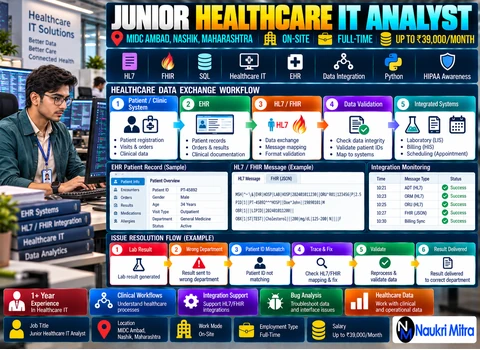
Nashik employers are hiring for a Junior Healthcare IT Analyst role based on-site in MIDC Ambad, full-time, paying up to ₹39,000 a month. It's an entry point into a niche corner of software development where the code you write actually touches patient records and clinical workflows, not just another internal dashboard.
Healthcare IT sits at an odd intersection. You're writing and maintaining application code as any junior developer would, but the systems involved carry real weight, since a bug here can mean a doctor sees the wrong lab result or a clinic's scheduling system falls out of sync with its billing.
What you'd actually be doing
Day-to-day, this role blends regular development work with the kind of context that healthcare systems demand. Expect to spend time:
- Writing and maintaining application code for systems used by clinics or hospital partners
- Collaborating with cross-functional teams, including clinical staff who explain what a workflow needs to do before it gets built
- Fixing bugs surfaced during testing, some of which trace back to how healthcare data gets formatted or exchanged
- Supporting data exchange between systems using healthcare messaging standards like HL7 or FHIR
- Documenting changes clearly enough that someone unfamiliar with the healthcare side can still follow what happened
Nobody expects a fresh graduate to already understand hospital billing cycles or insurance claim formats. Learning that context happens on the job, mostly through the bugs that force you to learn it.
One recurring example from the team's recent work: a diagnostic lab's reporting system was sending results to the wrong department roughly once a week, and the root cause turned out to be a mismatched patient identifier field between two systems that were never designed to communicate cleanly. Tracing that kind of issue is exactly the sort of work a junior analyst gets pulled into early, alongside someone more senior the first few times.
Skills
The role asks for some grounding in healthcare domain knowledge, basic familiarity with HL7 or FHIR concepts, and solid SQL. None of this needs to be deep expertise coming in. A junior candidate who's read up on how HL7 messages are structured, even without production experience, is already ahead of most applicants.
Beyond that baseline, a few things would help. Exposure to a major EHR platform such as Epic or Cerner, even through coursework or a personal project, gives an interviewer something concrete to talk through. Basic awareness of HIPAA and why patient data handling gets treated differently from ordinary application data matters too. Python, useful for quick data validation scripts, rounds out a strong application without being a hard requirement. A certification like CAHIMS isn't expected at this level, though anyone already pursuing one is welcome to mention it.
Education and experience
This position sets its degree bar at the bachelor's level in computer science, information technology, or a closely related field, which aligns with what most engineering colleges in and around Nashik and Pune already produce. The listed experience requirement is twelve months, so this isn't strictly a fresher role, but it also isn't asking for someone who's spent years in production healthcare systems already.
Pay and benefits
The salary for this healthcare IT analyst opening in Nashik is up to ₹39,000 per month. Health insurance, paid time off, and provident fund contributions come standard with the role. Since it's on-site in MIDC Ambad, relocation assistance and accommodation support are also part of the package for candidates moving from outside Nashik, which matters given how much of the applicant pool for healthcare IT roles in Maharashtra's tier-two cities tends to come from engineering graduates based in Pune or Mumbai looking for a lower cost of living without giving up meaningful technical work.
Growing into the role
Most junior analysts who join without a deep healthcare background spend the first few months mostly reading, sitting in on integration meetings, and asking questions that feel basic at the time but stop feeling that way fast. By the six-month mark, the expectation shifts toward independently owning smaller pieces of integration work, with a senior analyst reviewing before anything ships to a clinic partner.
Career paths from here tend to split two ways. Some analysts delve deeper into healthcare interoperability, working almost exclusively with HL7, FHIR, and EHR integrations. Others use the healthcare exposure as a stepping stone into broader backend development roles, carrying the domain knowledge as a differentiator even after moving to less specialized work.
The team and why this niche
Naukri Mitra has seen healthcare IT postings pick up noticeably across Maharashtra's smaller cities over the past couple of years, and Nashik, in particular, has a growing cluster of clinics and diagnostic chains digitizing records that used to be entirely on paper. That shift is what's driving demand for analysts who can bridge the software side with actual clinical operations.
The team here is small enough that a junior analyst gets visibility into decisions that would stay invisible at a larger company. When a clinic partner reports that lab results are arriving late, the person tracing the issue back to its root cause is often someone at exactly this level, not a senior architect three layers removed from the actual data.
Where it's based
The role is on-site in MIDC Ambad, Nashik, pincode 422010, Maharashtra. This isn't a remote arrangement, and candidates looking at healthcare IT analyst jobs near MIDC Ambad specifically should plan for a daily commute to that industrial area rather than the city center. For freshers in Nashik weighing this against a general software role elsewhere in the city, the healthcare specialization here is the main trade-off to think through compared with a broader, less specialized starting point.
Applying
Interested candidates should apply through the standard process attached to this listing, with a resume highlighting any coursework, internships, or personal projects that specifically touch healthcare data, HL7, or FHIR. Interviews typically include a brief coding exercise alongside a discussion of why healthcare IT appeals more than general software development, since genuine interest in the domain tends to matter more here than in a typical junior developer hire.