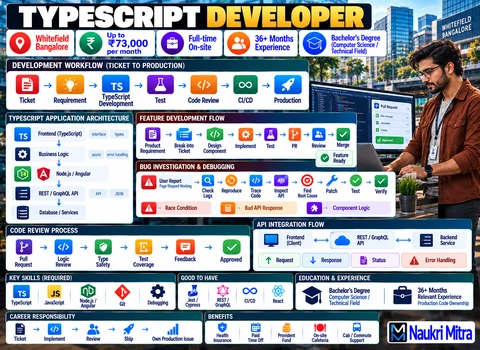
An on-site TypeScript Developer role is open in Whitefield, Bangalore, with a salary up to ₹73,000 per month. It's a full-time seat on a software development team, and the work is exactly what it sounds like: building and maintaining production TypeScript code that other teams depend on.
This isn't a role where you sit off to the side writing isolated scripts. You're building components that plug into a larger product, and product and QA teams will be in your inbox regularly, either handing off requirements or flagging something that broke. Expect a fair amount of back-and-forth on any given feature before it ships.
The team ships on a regular cadence, and most work comes in as tickets tied to a specific feature or bug rather than open-ended projects. A developer comfortable picking up a ticket, understanding the existing code around it, and shipping a fix or a feature without a lot of hand-holding will settle in quickly here. Anyone who needs a detailed spec written out for every small change will find the pace a bit much at first.
Responsibilities
- Design and build software components in TypeScript, from initial structure through to production-ready code
- Work closely with product managers to turn requirements into working features, and with QA to close out the bugs they find
- Review teammates' code for quality and consistency before it merges
- Troubleshoot issues reported by end users, tracing problems back through the codebase to find the actual cause
Bug reports rarely arrive with a clean explanation attached. A user might say a page "just stopped working," and it's on this developer to dig through logs, reproduce the issue, and figure out whether the real culprit is a race condition in a component, a bad API response, or something else entirely. Code reviews here aren't a rubber-stamp step either. Reviewers are expected to read through the logic and flag issues before they merge, not just check that the tests pass and move on. Anyone joining should be ready to give feedback and take it in equal measure.
What you'll need
Solid, working TypeScript is the baseline here, not a nice-to-have, since the codebase is typed end-to-end and a loose approach to types tends to surface as bugs a few weeks later. Beyond that:
- Strong JavaScript fundamentals underneath the TypeScript
- Experience with Node.js or Angular, since the team's stack leans on one or the other depending on the project
- Comfort with Git for day-to-day version control and code review
- Real debugging skills, not just familiarity with a debugger button
Nice to have
Prior exposure to a testing framework like Jest or Cypress will make onboarding faster, since the team writes tests alongside feature work rather than after. Familiarity with REST or GraphQL APIs helps, too, and anyone who's worked with a CI/CD pipeline before will find the deployment process here familiar rather than confusing. Some exposure to React alongside Angular is a bonus, since a couple of internal tools outside the main product still run on it. None of this is required on day one, but it shortens the learning curve considerably.
Education and experience
The degree requirement here is a bachelor's degree, typically in computer science or a similarly technical discipline. Naukri Mitra typically sees employers pair that with some hands-on exposure to the actual tools listed above, since a degree alone doesn't tell an interviewer much about how someone handles a messy production bug.
The role asks for 36 months of relevant experience. That generally means someone who's already shipped real features in a production codebase, not just built personal projects or completed a bootcamp, and who's comfortable owning a piece of the codebase without a senior developer checking every commit. Three years is roughly the point at which most developers have experienced a handful of production incidents firsthand, which matters more in this role than any specific framework version on a resume. Candidates a bit under that mark with a particularly strong TypeScript background are still worth applying, since the hiring team weighs actual code quality heavily during the technical round.
Compensation and benefits
Pay tops out at ₹73,000 a month for this position. On top of that:
- Health insurance
- Paid time off
- Provident fund contributions
- On-site cafeteria access
- Cab or commute support, standard for on-site roles at employers in this part of Bangalore
The provident fund piece is worth flagging for anyone new to full-time employment in India, since it's a mandatory retirement contribution deducted automatically rather than optional, and it appears as a separate line on every payslip.
Location and setup
This is an on-site position based in Whitefield, Bangalore. There's no remote or hybrid option for this posting, so anyone applying should be ready to work full-time in the office. For developers already browsing TypeScript developer jobs in Bangalore, this one sits squarely in Whitefield, one of the city's denser tech corridors, which makes the commute support worth factoring into any decision if you're coming from farther out. TypeScript developer salary in Bangalore per month varies a fair bit by seniority and stack, and this listing sits toward the mid-to-upper range for a three-year experience bracket. Whitefield itself has enough IT parks nearby that finding a rental within a short commute isn't difficult, though traffic during peak hours can still add real time to the trip depending on where someone's coming from.
Applying
Put the actual stack you've worked in front and center on the resume. TypeScript, Node, or Angular specifically- whichever tests or CI tools you've touched. That's what gets a resume pulled for a first look in a stack like this one. Listing a GitHub link with real, non-tutorial projects helps more than another paragraph of soft-skill adjectives ever will.
The next step after an initial resume review is usually a short technical conversation, sometimes with a small coding exercise attached, focused on how a candidate actually debugs something rather than trivia about syntax. Candidates who can talk through a real bug they've fixed, start to finish, tend to stand out more than ones reciting a list of frameworks they've read about.