Associate API Integration Developer, Mahindra World City, Jaipur
A team at Mahindra World City, Jaipur, needs an Associate API Integration Developer, full-time and on-site, with a salary up to ₹61,000 per month. The job is exactly what the title says: connecting systems that weren't built to talk to each other and making sure data actually moves between them correctly.
This isn't a role where you're inventing a product from a blank page. Third-party vendors, internal services, and partner platforms each have their own APIs, quirks, and ways of failing quietly when something changes upstream. Someone needs to catch that before it breaks a downstream process, and that's the job.
Most of the integrations already exist and are working today. The job is as much about keeping that in place as it is about building new connections, which is a different skill than greenfield development and one that doesn't always get enough credit in how these roles get described elsewhere.
What the work looks like
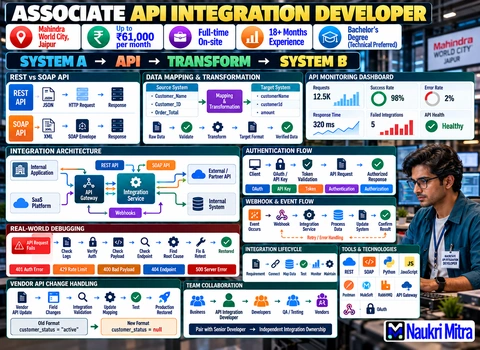
- Build and maintain integrations between internal systems and external APIs, both REST and SOAP depending on the vendor
- Write and test integration scripts that handle data mapping, transformation, and error cases cleanly
- Debug failed API calls, tracing issues back to payload formatting, authentication, rate limits, or endpoint changes on the other side
- Monitor existing integrations for failures or degraded performance, and fix what breaks before it cascades
- Document integration specs and data flows so the next developer touching a connection isn't reverse-engineering it from scratch
Vendors change their APIs without much warning more often than anyone would like. A field that used to return a string starts returning null, or an endpoint gets deprecated with two weeks' notice buried in a changelog nobody reads. Catching that quickly, before it shows up as a support ticket from a confused end user, is a real part of the job.
New integrations get built on request, usually when the business signs up a new vendor or wants to connect a tool that's already in use elsewhere in the company. That side of the work involves reading unfamiliar API documentation quickly, sometimes documentation that's incomplete or slightly out of date, and figuring out the gaps through testing rather than assuming the docs are right.
Who this role is for
The minimum requirement is a bachelor's degree, most commonly in a technical field, though the hiring team here cares more about demonstrated ability in integration work than the exact degree title on the certificate. Eighteen months of hands-on experience is expected, ideally with real exposure to connecting systems through APIs rather than purely internal application development.
Candidates who've worked with API gateways, webhook-based integrations, or middleware connecting SaaS tools tend to ramp up faster here, even if their previous title didn't include "integration" anywhere.
Skills you'll actually use
- Solid working knowledge of REST APIs, and enough SOAP experience to handle the older systems that still run on it
- Comfort with a scripting language for automation and data transformation; Python or JavaScript both work here
- Genuine debugging ability, reading logs, tracing failed requests, and isolating where in the chain something broke
A step ahead of other applicants
Experience with an integration platform such as MuleSoft, Postman for testing and automation, or a message queue like RabbitMQ will stand out on a resume. Familiarity with OAuth and API authentication schemes generally saves ramp-up time, since a fair share of integration bugs trace back to authentication rather than the actual data logic.
Pay and benefits
Along with the monthly salary, medical coverage and a provident fund contribution are part of the standard package, and paid leave accrues from the start rather than kicking in after a waiting period. Naukri Mitra notes that Jaipur has become a genuine draw for mid-level developer roles over the past couple of years, partly because compensation here has narrowed the gap with bigger metro cities. For anyone relocating to Jaipur specifically for this role, the employer covers moving costs and helps with finding accommodation during the first few weeks.
Working in Mahindra World City
Mahindra World City sits a bit outside Jaipur's older commercial core, which means less traffic congestion but a slightly longer commute for anyone living centrally. It's a planned development with a fair number of tech and manufacturing companies clustered together, so there's decent infrastructure around the office itself, cafes, ATMs, the basics.
For anyone weighing this against a role closer to the city center, the trade-off is generally a quieter, more predictable commute in exchange for fewer lunch options within walking distance. It's a fair trade for most people who've tried both, though it's worth knowing going in rather than discovering it in the first week.
The team here is small enough that new hires get direct time with senior developers rather than being routed through a formal training program. Most ramp-up happens by pairing on real integration tickets during the first month, which tends to be faster than sitting through generic onboarding material.
There's a decent amount of autonomy once someone's past that first month. Nobody's checking in on every ticket, and the expectation is that problems get flagged when they're genuinely stuck rather than after burning half a day quietly. That balance- some structure early on and real independence after- seems to work well for people at this stage of their career.
Applying
Send a resume that calls out specific APIs or integration platforms you've worked with, along with any concrete examples of debugging a tricky integration issue. Shortlisted candidates go through a technical screening built around a real integration scenario rather than abstract coding puzzles, since that's a closer match to what the job actually involves day-to-day.
If you're coming from a general software development background without direct integration experience, mention any project, even a personal one, where you connected two systems that weren't designed to work together. That's a stronger signal of real fit than a list of frameworks on its own, and it's exactly the kind of detail the hiring team looks for during screening.